Page Level Ads

The great circle crosses the equator at 114° E

The great circle crosses the equator at 114° E. It will cross the equator at what other longitude?

Given:
          Longitude = 114° E

What is asked:
          Longitude where the great circle passes the equator at the west                       longitude.

Solution:

Step 1. Add 180° to the longitude.
          114° + 180° = 294°

Step 2. Subtract 360° by your answer at step 1.
           360 - 294 = 066°

So the answer is 066° West.


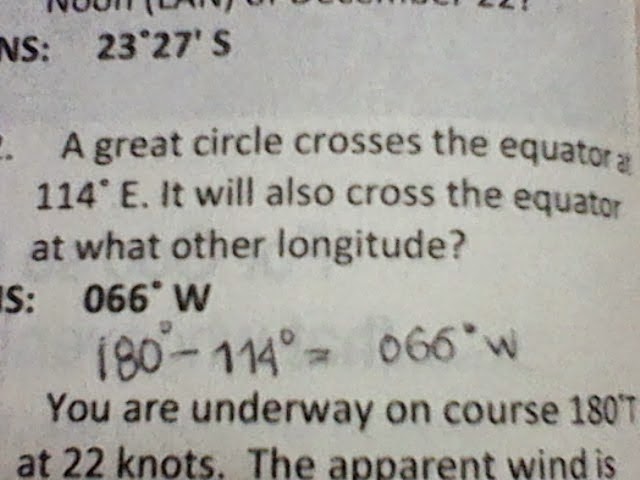
The solution above is, I would say, a proper one in dealing this kind of nautical problem. However, as you can see in the diagram, we can make a shortcut solution. Here's how:

Always subtract 180° by the given longitude.

So, 180° - 114° = 066° West.

Thanks.

Solving Angle At The Pole

The distance between two meridians is 427 nautical miles in latitude 50° 20' N. What is the angle at the pole?

Given:
         427 nm - Distance between two meridians
         Latitude 50° 21' N

What is asked:
         Angle at the pole

Solution:
         This is the formula for getting angle at the pole.

           Angle at the pole = (distance / Cos Lat)  ÷ 60

Step 1. Divide the distance by cosine of latitude.
         
            427 nm ÷ Cos 50° 20' = 668.94 nm

Step 2. Divide 668.94 by 60 to convert it into degrees. And result will be the angle the pole.

            668.94 ÷ 60 = 11° 08.9' is the angle at the pole.

Angle at the pole


Set And Drift Formula

At 1200H you fix your position and change course to 315°T. At 1225H, you again fix your position, and it is 0.9 mile southwest of your DR position. Which statement is true?

Given:
1200H - Time of ship's first position
1225H - Time of ship's second position
0.9 miles - Distance between fix and DR position

What is asked:
1. Drift
2. Current Set

Solution:
This is the formula for ship's drift: Drift = (Distance/Time) x 60

Step 1. Get first the time interval.
           TI = 1225H - 1200H = 25 mins

Step 2. Divide the distnce by time interval.
                      0.9 miles ÷ 25 mins = 0.036

Step 3. Multiply the answer of step 2 by 60 to convert it into knots.
                     0.036 x 60 = 2.16 knots is the speed of drift.

For getting the set of current you can just determine it by analyzing the problem. The problem says that your second fix position is "0.9 mile southwest of your DR position". Your keyword here is "southwest". Since southwest is equivalent to 225°, therefore the set of current is 225°.

Set and Drift Formula

If you find this helpful, why not tell or link your friends to this blog.


Solving For The Difference Of Longitude (Dlo)

In latitude 50° 10' N, the departure between two meridians is 360 nautical miles. What is the Difference of Longitude?

GIVEN:

   Latitude =  50° 10' 
Departure = 360 nm         

WHAT IS ASKED:  Difference of longitude

SOLUTION:

This is the formula in solving for the difference of longitude:

Dlo = (Dep/Cos lat) ÷ 60

Step 1. Divide the departure by Cosine latitude.
           360 ÷ Cos 50° 10' = 562 nm

Step 2. Divide the answer of step 1by 60 to convert it into degrees.
           562 ÷ 60 = 9° 22' is the difference of longitude (Dlo).


Difference of Longitude
Related Posts

How To Solve Ship's New Draft

A vessel is alongside a berth where the density is 1000 kgs/m3  with a draft of 36'-04". What would she draw in salt water having a density of 1026 kgs/m3?

GIVEN:

 Old density = 1000 kgs/m3 
     Old draft = 36' 04" or 36.33 ft
New density = 1026 kgs/m3 

WHAT IS ASKED:

Ship's new draft

SOLUTION:

This is the formula in getting ship's new draft.


Step 1. We have to multiply ship's old draft by old water density.

            36.33 ft x 1000 = 36330 ft

Step 2. Divide the answer of step 1 by the new water density.

            36330 ÷ 1026 = 35.40936 ft

So the answer is 35' 05".

Wondering where I got 5 inches? I convert 0.40936 ft into inches by muliplying it by 12.

0.40936 ft x 12 inches/1 ft = 05" 

How To Determine Whether The Ship Is Sagging or Hogging

The forward draft of your ship 36' 04" and the after draft is 40' 02". The draft amidship is 38' 08". Your vessel is:


SOLUTION:

Step 1. We have to get the mean draft. Let us add forward and after draft.

36' 04" + 40' 027" = 76' 06"

And then divide the sum of the two drafts by 2.

76' 06" ÷ 2 = 38' 03" is our mean draft.   

Step 2. Let us analyze whether our ship is in hogging or sagging condition.

By the given drafts forward and aft, the waterline amidships should be at 38' 03". However, the actual draft at amidships is 38' 08". Therefore, the vessel is sagged.


The vessel is sagging


You Might Also Like

Calculating The Shift Of The Center Of Gravity After You Move The Cargo

A vessel's displacement is 300 tons has 15 tons of deck cargo. What will be the shift in the center of gravity after you move the cargo to the hold a vertical distance of 8 feet?

SOLUTION:

Shift in the center of gravity = (weight x distance) ÷ displacement
                                      gg1 = ( 15 tons x 8 feet ) ÷ 300 tons
                                             = 120 ÷ 300
                                             = 0.4 feet is the answer


Shift In The Center Of Gravity


You Might Also Like

Safe Working Load Formula (SWL)

The breaking strain of a nylon line is rated at 15,000 kgs. Using a safety factor of 5, what is the safe working load (SWL)?

SOLUTION:

Safe working load (SWL) is equal to the quotient of breaking strength divided by the safety factor.

This is the Safe Working Load formula:

SWL = BREAKING STRENGTH ÷ SAFETY FACTOR
SWL = 15,000 kgs ÷ 5
SWL = 3,000 kgs 

 See this picture.


Safe Working Load Formula

Solving For Vessel's Trim

A vessel has a fwd and aft drafts of 28'-00" and the MTI is 1700 ft-tons. 250 tons of water is pumped from the forepeak into the after peak at a distance of 574 feet. What will be her trim after pumping is complete? (Tipping center is assumed to be at vessel's mid length).

ANALYSIS OF THE PROBLEM:
Our ship's trim is said to be "even keel" since we have the same draft forward and aft. However, a 250 tons of water from the forepeak is to be transferred into the after peak tank. So what will happen after pumping out is that there will be an increase in draft aft and a decrease in draft forward because the tipping center is at vessel's mid length.

SOLUTION:

We have to use the formula for Change Of Trim (COT)
COT = (WEIGHT X DISTANCE)  ÷ MTI

Step 1. Multiply weight and distance.
              250 tons x 574 ft = 143500 ft-tons

Step 2. Divide the answer of step 1 by the MTI.
               143500  ÷ 1700 = 84.41176 inch is our change of trim.

Step 3. Divide COT by 2 to get the "half trim".
             84.4  ÷ 2 = 42.20588 inch

            We have to convert this into feet since the unit of ship's draft is in feet by dividing it by 12.
              42.20588 inch  ÷ 12 = 3.51715 ft or 3' 6.20" is our "half trim"

Step 4. The foreward draft is to be subtracted by "half trim" because it is  the forepeak tank that is being pump-outed.
               28' 00" - 3' 6.20" = 24' 05.8"
And the draft aft is to be added by "half trim" since it is the after peak tank where 250 tons of water is pumped into.
             28' 00" + 3' 6.20" = 31' 06.2"

So the answer is 24-05.8 FWD and 31-06.2 AFT.


You Might Also Like


Finding Ship's New Draft

A vessel enters port with an arrival draft of 11 meters at sea water density. If her FWA is 254, what will be her draft in dock water with relative density of 1.009?


ANALYSIS OF THE PROBLEM:

The vessel is from the sea going to a brackish water. Since there is a change in water density, so what will happen to its draft? In the case of a ship from the sea to a brackish water, the draft will increase.
Therefore, we can expect that the answer of this problem is more than 11 meters.

SOLUTION:
We can use the formula in getting allowable increase (AI)


Step 1. We have to get the difference of density by subtracting sea water density by dock water density.  

            1.025 - 1.009 = 0.016

Step 2. Multiply the answer of step 1 by the fresh water allowance (FWA).
             0.016 x 254 = 4.064

Step 3. Divide the answer of step 2 by 25.
              4.016 ÷ 25 = 0.16256 meters

Step 4. We have to add the answer of step 3 to our original draft.
             11 m + 0.16256 m = 11.16 meters is our final answer.

Note: We add the answer of step 3 to our original draft because the ship is coming from the sea to a brackish water.

Do you have another way of solving this problem? Why not comment and share it to us.


You Might Also Like

Solving For Compass Deviation

While proceeding up a channel on a course of 010° T per gyro compass you notice a pair of range lights in alignment with the masts of your vessel when viewed forward. A check on the chart shows the range to be 009° T and the variation on the compass rose to be 15° W. If the ship's course is 026° psc, what is the deviation on the present heading?

SOLUTION:

Have you heard that "true virgin makes dull companion"? We are going to use that mnemonic.

        TRUE = 009°
VARIATION = 15° W
MAGNETIC = 024°
DEVIATION = __?
COMPASS = 026°

As we can see in tabulation above, we have no entry for the deviation. So what value and sign of deviation are we going to add or minus to the magnetic?

Since our magnetic is 024° and our compass is 026°, so we can now understand that the deviation must be 2°. But what will be the sign? In true to compass (uncorrecting), west is to be added. So 2° W will be the deviation.


You Might Also Like

Bow And Beam Bearing Problem

A ship steaming on a course of 246° T at 17 knots. At 2107 a lighthouse was observed bearing 207 deg T and at 2119 the same lighthouse bears 179° T. What is the ship's distance off at second bearing?

SOLUTION:


Step 1. We have to get the angle at first and second observation. That is we to have subtract our course by   the observed bearings.

  • 246° - 207° = 39° as our angle at first observation (<A)
  • 246° - 179° = 67° as our angle at first observation (<B)
Step 2. We have to get the time interval by subtracting time at first and second observation.
  • 2119H - 2107H = 12 mins
Step 3. Multiply the answer of step 2 by ship's speed & then divide by 60.
  • (12 mins x 17 knots)  ÷ 60 = 3.4 miles
Step 4. Multiply the answer of step 3 by Sin <A.
  • 3.4 x Sin 39° = 2.14
Step 5. Divide answer of step 4 by the difference of angle A and angle B
  • 2.14  ÷ Sin 28° = 4.56 miles... is the ship's distance off at 2nd bearing.

Solving For Latitude

In what latitude will a departure of 200 nm corresponds to a Dlo of 4° 16'?


SOLUTION:

The formula is Cos Lat = departure ÷ Dlo

Step 1. Since Dlo is given in degrees, we have to convert it first into miles.
                Dlo = 4° 16' x 60 = 256

Step 2. Divide departure by Dlo.
               200 ÷ 256 = 0.78125

Step 3. Inverse cosine the answer in step 2

I hope you have followed. Thanks.


Related Posts

A Westbound Vessel Will Cross The Equator In What Longitude?

The vertex of a great circle track is long. 029° W. A westbound vessel will cross the equator in what longitude?


SOLUTION:

  The rule in this kind of problem is  +90° or -90° to the longitude. You might ask, when are we going to add or minus 90°? These are the instances:
 +90° if: 

  • Longitude is west and the vessel is westbound
  • Longitude is east and the vessel is eastbound

-90° if:
  • Longitude is west and the vessel is eastbound
  • Longitude is east and the vessel is westbound
So in this problem our longitude is  029° W and our direction is west, therefore, we have to add 90° to the longitude. 

029° W + 90° = 119° W.

If answer is >180°:
                             360°- ANS and then change the sign of longitude.


Related Posts

How To Solve The Latitude Of The Parallel

On a certain parallel, the distance between two meridians is 320 nm. On the equator the distance between the same two meridians is 680 nautical miles. What is the latitude of the parallel?

ANALYSIS OF THE PROBLEM:

If the distance between two meridians at the equator (latitude 0°) is 680 nm, the question then is what will be the latitude if the distance between these two meridians is 320° nm?


SOLUTION:


This is formula: Cos latitude = 320 ÷ 680


Step 1. divide 320 by 680

               
320 ÷ 680  = 0.47059

Step 2. We have to inverse cosine the answer of step 1.

0.47059 inv Cos =  61° 55.6' N or S is the answer.


Related Posts

Rate per Hour At Latitude Carried Around Earth's The Axis

At what rate per hour is latitude 60°00' S being carried around around the earth's axis.


GIVEN:    60°00' S latitude

WHAT IS ASKED: Rate per hour at latitude 60°00' S

ANALYSIS OF THE PROBLEM:

The circumference of the earth at equator is 21,600 nm. So 900 nm/hr is the speed at the equator because earth can finish its rotation in 24 hrs according to textbooks. Though I have to say that I do not believe that the earth rotates around its axis. ( I begin to love geocentrism now).

However, the earth has an oblate spheroid shape. So there must be a difference of circumference at latitude 60°00' compared to the equator. The salient point in the problem is this: If 900 nm is the speed of the earth at the equator, how much then is its speed at latitude 60°00' S?

SOLUTION:

 Speed = 900 x Cos lat
            = 900 x Cos 60°00'
            = 450 nm


I hope this post is helpful to you. If you want to say something, your comment is very much welcome.


Determining How Many Shackles To Be Paid Out

The depth of water in the anchorage is expected to be 45 feet. How many shackles to be paid out if a scope of 6 is desired on the anchor chain.

GIVEN:

 Depth = 45 ft
Scope = 6

SOLUTION:

45 ft x 6 = 270 ft x 1 shackle  = 270 = 3 shackles
                                 90 ft          90


Related Posts

Finding Scope of an Anchor

Find the scope of an anchor cable with six shackles paid out in a depth of 72 feet.


GIVEN:   6 shackles
              72 feet depth

WHAT IS ASKED: Scope of an anchor

SOLUTION: First, is important to know the conversion factor:
                        1 shackle = 90 feet
                        1 shackle = 27.44 meters 

 6 shackles x 90 ft ÷ depth = scope
   6 shackles x 90 ft ÷ 72 ft = 7.5

I used 90 ft to multiply it by 6 shackles because the unit of the depth is feet. What if the unit of depth is in meter? You use 27.44 meter.


See Related Problem


Solving For True Wind Direction

Your vessel is on course  180°T, speed 22 knots. The apparent wind is from 70° off the port bow, speed 20 knots. The true wind direction and the speed of the wind are________.

Given:                Own course = 180°T
                            Own speed = 22 knots
                      Apparent angle =  70°
             Apparent wind speed = 20 knots

What is asked: 
  1. True wind direction
  2. True wind speed
Solution:   

 Note: We have to solve first the true wind speed before we can proceed into solving true wind direction. Regarding how to solve "true wind speed", I'll refer you my other post so that I can proceed directly to solve for the true wind direction. Here's the link: solving for true wind speed.

This is the formula for true wind direction: 

True Wind Directon = Apparent wind speed² - True Wind Speed² - Own Speed²
÷ 2 x True Wind Speed x Own Speed. Then inv cosine.


And then the result will be added or subtracted to Own Course.

True Wind Direction=20²-24²-22²÷2x24x22
                                           -660÷(2x24x22) = -0.625 inv COS = 129°

Now, Own Course 180°-129°= 51° is the True Wind Direction. I subtract because the apparent wind is in the bow. You might ask, what if the apparent wind is located at the quarter? You have to add it.


Related Posts

Solving For Apparent Wind Speed

Your vessel is on course 135°T, speed 18 knots. From the appearance of the sea you estimate the speed of the speed of the true wind as 24.5 knots. The apparent wind is 40° on the starboard bow. Determine the speed of the apparent wind. 

Given:         Own speed = 18 knots
            True wind speed = 24.5 knots
      Apparent wind Angle = 40°

What is asked: Apparent wind speed

Solution:  Own speed² + True wind speed² + 2 x Own speed x True wind speed x Cos 40° and then square root the answer to get the apparent wind speed. This the formula for apparent wind speed

Apparent wind speed = √18² + 24.5² + 2 x 18 x 24.5 x Cos 40° = 39.99 knots  

Well, as you notice, there's a little discrepancy if we are going to compare our computed answer with the official answer which is 36.0 knots. So what shall we do? My instructor during my review used to advice us to choose the nearest answer in cases like this. That is to select the best answer, so to speak.


Apparent wind speed

This is very problem taken from my reviewer book. 

Feel free to comment.


See Related Problem